

Lead image: AI-generated editorial illustration for Alt Asset Asia. Conceptual scene, not a photograph of interviewees or an ABIEL property.
HSBC’s research shows a sharp decline in younger affluent investors’ medium-term confidence. In a written interview with Alt Asset Asia, ABIEL founder Maureen Li argues that the timing and accessibility of wealth matter as much as its size.
TL;DR
- Medium-term confidence among Singapore’s affluent Gen Z respondents fell from 73% to 48%, according to HSBC’s 2026 Global Affluent Investor Snapshot.
- The findings concern people aged 21–29 with at least US$100,000 in investable assets, not young Singaporeans generally.
- Li identifies housing and competing financial commitments as sources of anxiety, while acknowledging that her observations do not establish what caused the survey result.
- Property exposure is not a substitute for accessible savings: falling values, financing costs and delayed exits can undermine financial plans.
Singapore’s affluent young investors have capital to invest. That does not mean they feel confident about what it will buy them.
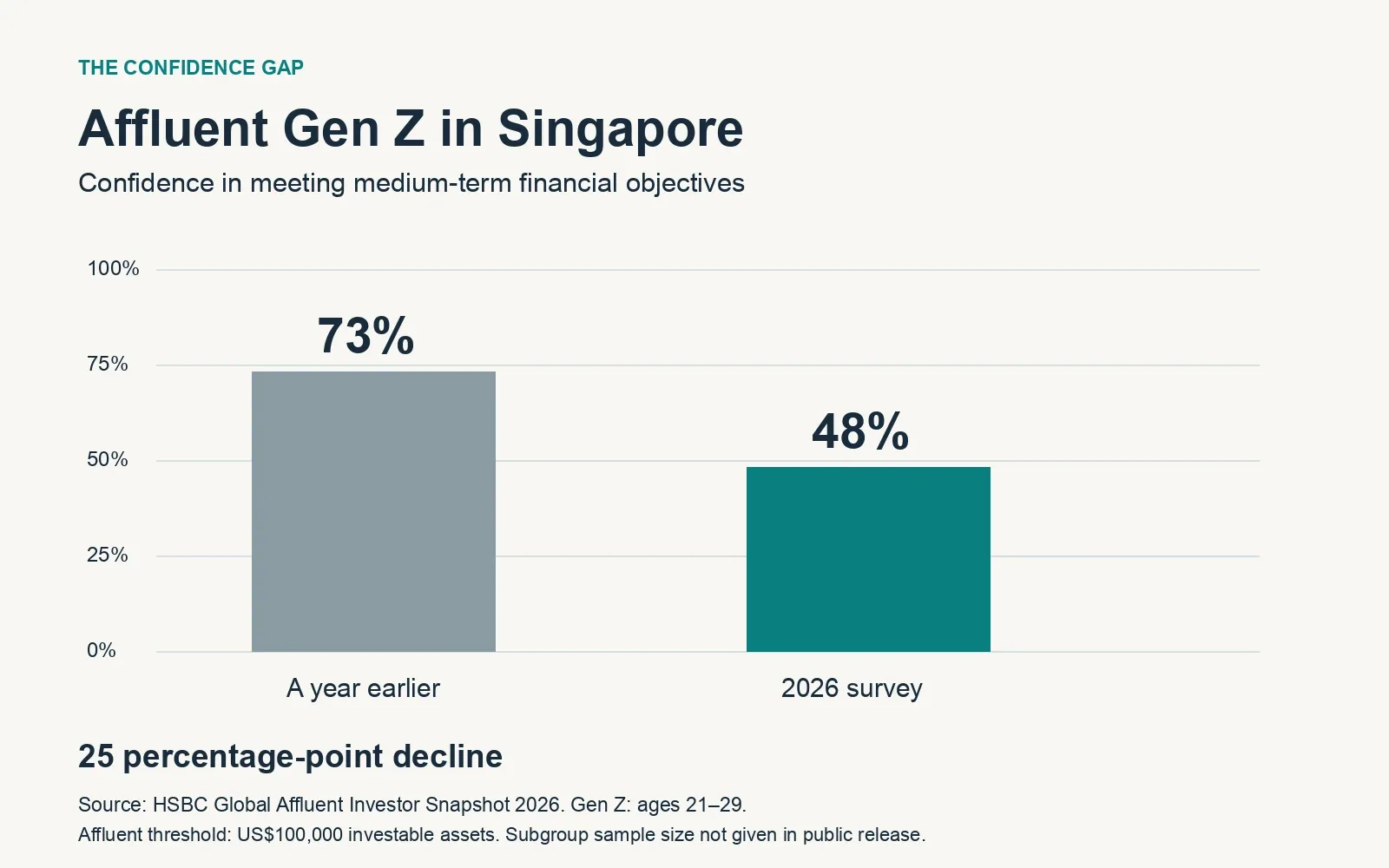
HSBC’s 2026 Global Affluent Investor Snapshot found that medium-term confidence in meeting financial objectives among affluent Gen Z respondents in Singapore had fallen to 48%, from 73% a year earlier. That is a decline of 25 percentage points.
At the same time, 58% prioritised building wealth for financial security and 51% focused on creating additional income streams. Those figures describe priorities, however, not proof that respondents’ wealth had increased.
The distinction matters. An ambition to accumulate assets is not the same as having accumulated them, and neither necessarily means having money available for a home, family commitments or an unexpected expense.
“Capital alone does not create security,” Maureen Li, founder and CEO of ABIEL Property Investment Fund, said in a written interview supplied to Alt Asset Asia. “Security comes from knowing what each dollar is working towards and when you can reach it.”
A wealthy subset, not a generation-wide verdict
HSBC defines Gen Z in this study as people aged 21–29. Its affluent threshold is at least US$100,000 in investable assets.
The research, conducted by Ipsos Asia Limited, surveyed 9,993 investors aged 21–69 across 10 markets between 6 January and 6 February 2026. That is the full international sample, not the number of affluent Gen Z respondents in Singapore.
The public release does not give the Singapore Gen Z subgroup’s sample size or uncertainty estimates. It therefore establishes a reported change in confidence, but does not by itself explain its cause or allow readers to assess the precision of that subgroup comparison.
Li was explicit about the limits of her own evidence. ABIEL does not hold HSBC’s underlying data, and cannot separate earned wealth from inheritance or family support within the survey population.
Her experience of young investors is also selective.
“We should be honest that we only see the success stories,” she said.
That admission is important when interpreting a story about wealth and insecurity. Investors who reach a property investment firm are not a representative sample of everyone in their twenties.
Housing makes the timing problem visible
In Li’s experience, anxiety often centres on living costs and major purchases that younger investors have yet to make, particularly a first home.
Marriage, children and housing can create competing demands for capital within a relatively short period. A portfolio may look substantial while still feeling inadequate against those commitments.
Li also sees a different problem among people who have already bought: concentrating wealth in a home can leave little flexibility elsewhere.
But she cautioned against treating housing as a complete explanation.
“It would be too simplistic to attribute financial anxiety primarily to housing,” she said. “Property is one significant contributor among several, rather than the sole cause.”
Employment stability, debt, dependants and other household obligations also matter. Her observations provide context for the confidence gap, rather than evidence that housing caused the decline reported by HSBC.
Looking overseas is a preference, not a portfolio measurement
The HSBC study also found that 55% of affluent Gen Z respondents in Singapore preferred investment exposure outside their home market. That compares with 50% of Singapore’s broader affluent segment and 49% of affluent Gen Z globally.
These figures should not be read as the percentage of their money already invested abroad.
Li said the younger investors she knows generally retain Singapore stocks as a core holding, with global exchange-traded funds and overseas shares alongside them. That is her observation of investors she encounters, not a breakdown of HSBC’s sample.
The difference between preference and allocation is central to the story. Wanting more international exposure says something about investment intentions, but does not establish how diversified a portfolio already is or why an individual chose particular assets.
Property brings its own liquidity problem
Li’s perspective comes from a business with a commercial interest in property investment. Her assessment should be read with that context, not as independent evidence that property offers a superior answer to financial insecurity.
In the interview, she acknowledged the risks plainly.
“If rents fall, distributions fall. If prices fall, capital falls and leverage amplifies the loss,” she said.
Higher financing costs can squeeze cash flow, while a lack of a ready secondary market can prevent an investor from exiting when they want to. A property investment may require a longer holding period than expected, and an exit may depend on an eventual asset sale or the specific contractual arrangements.
For someone saving for a near-term home deposit, that creates an obvious mismatch: the investment may not be saleable at the time, or at the value, required.
An asset that generates income can still lose value. It can also leave its owner short of accessible cash.
The confidence gap is not a product recommendation
The original media alert brought together findings from HSBC, Deel/YouGov, Deloitte and Sun Life. Those studies cover different populations and measures. They cannot be stitched together to show that the same individuals are becoming wealthier, taking on extra work and feeling less secure.
The public-relations representative supplying the interview said the underlying questionnaires, subgroup counts and cross-tabulations were not available from them.
What the verified HSBC findings support is narrower, but still significant: a surveyed group of young affluent investors reported weaker confidence even while wealth creation remained a priority.
Li’s interview adds a practical interpretation. Financial security is not simply a total on a balance sheet. It also depends on whether assets, obligations and access to cash fit together.
For young investors, the question is therefore not only how much wealth they can build. It is whether that wealth will be available when their lives require it.
Frequently asked questions
Who counts as affluent Gen Z in HSBC’s study?
HSBC defines Gen Z as respondents aged 21–29, with an affluent threshold of at least US$100,000 in investable assets. These findings should not be generalised to all young Singaporeans.
How much did financial confidence fall?
Medium-term confidence among affluent Gen Z respondents in Singapore fell from 73% to 48%, a decline of 25 percentage points. The public release does not provide the subgroup sample size or uncertainty estimates needed to assess the precision of that comparison.
Does the research show that young investors are getting wealthier?
The quoted findings identify financial priorities and confidence levels. They do not establish that the same respondents increased their wealth while becoming less confident, or separate investment gains from savings and family transfers.
Does 55% overseas preference mean 55% of portfolios are invested abroad?
No. It is the proportion of affluent Gen Z respondents in Singapore who prefer investment exposure outside their home market, not the share of their portfolios already invested overseas.
Why can property ownership leave an investor short of cash?
Property can tie up capital while mortgage payments, maintenance and other expenses continue. Falling rents or values and higher financing costs can worsen the position. Selling may take time, and the sale price may be lower than expected.
Is property investment suitable for money needed for a home deposit?
Money needed on a near-term date can be poorly matched to an illiquid investment. Holding periods may extend, and an exit may depend on an asset sale or contractual terms. Suitability depends on liquidity needs, the ability to absorb losses and the specific investment, not simply an expectation of income or appreciation.
Editorial note: This article draws on HSBC’s public research release and a written interview with Maureen Li supplied through Ellerton & Co. on 26 October 2026. Interview observations are attributed and have not been treated as representative survey findings. This is general information, not personal investment advice. Investments can lose value, and illiquid assets may involve extended holding periods and uncertain exit timing.
Sources
- HSBC: Singapore’s affluent Gen Z look beyond borders to build wealth, accessed 27 October 2026.
- “Interview with Maureen Li - Alt Asset Asia.docx”, five-page written response supplied by Ellerton & Co., 26 October 2026. Private source retained by the editor.