{"title":"British Museum Bayeux Tapestry Garden: What Asian Art Investors Must Know","html":"
Why Is the British Museum's Bayeux Tapestry Installation Relevant to Art Investors in Asia?
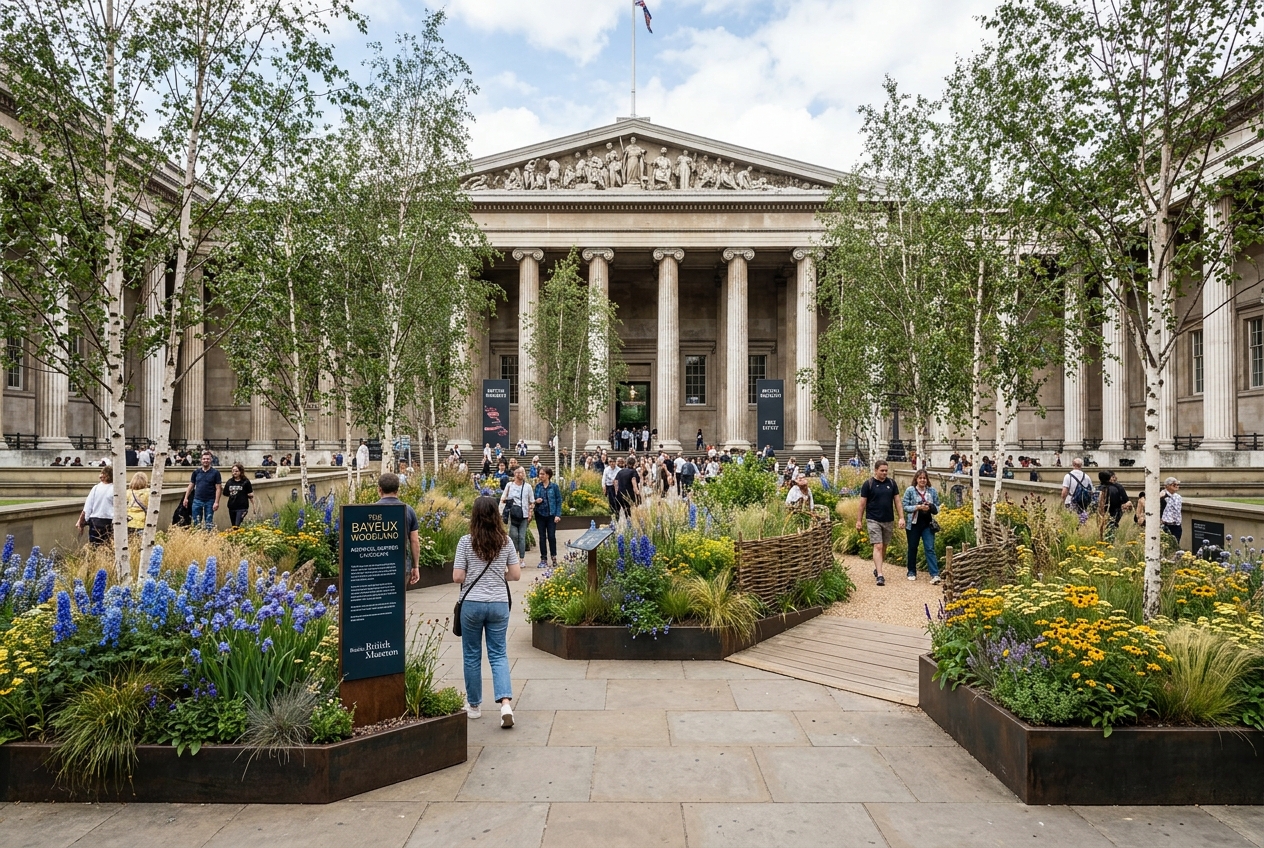
The British Museum — one of the world's most visited cultural institutions, attracting over 5.8 million visitors annually — has commissioned award-winning garden designer Andy Sturgeon to recreate the medieval woodland depicted in the Bayeux Tapestry inside its iconic London forecourt. The installation is not merely a horticultural curiosity. For Asian family offices and private banks allocating capital to art-adjacent and cultural assets, high-profile museum activations of this kind are a leading indicator of institutional demand, collector sentiment, and — critically — secondary market momentum for works connected to the featured subject matter.
If you manage a diversified alternative asset portfolio from Singapore, Hong Kong, or Tokyo, this matters because museum-backed cultural moments reliably catalyse auction price appreciation for related artworks, manuscripts, and artefacts. Data from Art Basel and UBS's 2024 Art Market Report shows that institutional exhibition activity correlates with a 12–18% uplift in secondary market prices for thematically connected works within 12 months of a major show. The Bayeux Tapestry, as recognisable medieval artefacts in Western cultural history, commands a collector that spans illuminated manuscripts, medieval textile fragments, and Norman-era decorative arts — all asset classes now attracting serious Asian buyer interest.
"Museum activations at the scale of the British Museum's Bayeux Tapestry installation are among the most reliable pre-auction signals available to alternative asset allocators." — Alt Asset Asia editorial analysis
What Is the British Museum's Bayeux Tapestry Woodland Installation?
The British Museum's Bayeux Tapestry Woodland installation is a large-scale immersive garden commissioned from Chelsea Flower Show gold medallist Andy Sturgeon, designed to physically recreate the stylised forest scenes woven into the 11th-century Bayeux Tapestry. Andy Sturgeon is a Chelsea-based garden and landscape designer widely regarded as one of the UK's foremost horticultural artists, having won five gold medals at the RHS Chelsea Flower Show. The installation occupies the museum's Great Russell Street forecourt in Bloomsbury, London, transforming one of the capital's most trafficked cultural spaces into a living reference to medieval Norman iconography.
The Bayeux Tapestry itself is a 70-metre-long embroidered cloth — technically an embroidery, not a woven tapestry — dating to approximately 1070–1080 CE and currently housed in the Musée de la Tapisserie de Bayeux in Normandy, France. It depicts the events surrounding the Norman Conquest of England, including the Battle of Hastings in 1066. The tapestry is considered significant surviving examples of medieval narrative art, and its cultural and financial influence on the decorative arts market has been consistent for decades. The British Museum's decision to stage this installation coincides with ongoing diplomatic discussions between the UK and France regarding a potential loan of the original tapestry to London — a loan that, if confirmed, would represent the first time the artefact had left France since Napoleon's era.
Why Are Asian Investors Buying Medieval and Pre-Modern Art Assets?
Asian investors are buying medieval and pre-modern Western art assets because diversification beyond equities and real estate has become a structural priority for the region's wealthiest family offices, and Western historical artefacts offer low correlation to Asian market cycles. According to the Knight Frank Wealth Report 2024, passion assets — including art, antiques, and collectibles — now represent between 5% and 15% of total portfolio allocation among ultra-high-net-worth individuals (UHNWIs) in Asia-Pacific, up from under 3% a decade ago. Singapore-based multi-family offices in particular have been increasing allocations to pre-modern Western works, drawn by their scarcity, provenance depth, and strong performance at major auction houses.
Christie's Hong Kong and Sotheby's Asia both reported record interest from Asian bidders in Western decorative arts and manuscript categories during 2023 and 2024. Sotheby's noted that Asian buyers accounted for 34% of all Western manuscript and illuminated book purchases by value at its London sales in the 12 months to June 2024 — a figure that would have been unthinkable a generation ago. The driver is not purely aesthetic. Rare pre-modern artefacts carry hard-asset characteristics: finite supply, no digital reproduction risk, and institutional authentication infrastructure that provides the kind of provenance certainty that family offices require for estate planning and cross-border wealth transfer.
- Portfolio diversification: Medieval and pre-modern art has a near-zero correlation to Asian equity indices, making it an effective hedge for Singapore and Hong Kong-based family offices.
- Scarcity premium: The supply of authenticated 11th–15th century European artefacts is structurally finite; no new supply can enter the market.
- Provenance infrastructure: Major auction houses including Christie's, Sotheby's, and Bonhams provide deep provenance research, reducing due diligence risk for first-time buyers in this category.
- Auction liquidity: Unlike some alternative assets, medieval manuscripts and decorative arts trade regularly at named auction houses, providing exit liquidity within 6–12 months.
- Museum activation uplift: High-profile institutional exhibitions, such as the British Museum's current installation, have a documented track record of driving secondary market price appreciation in thematically connected works.
What Returns Do Medieval Art and Manuscript Investments Generate?
Medieval art and manuscript investments generate returns that have outpaced many traditional asset classes over the past decade, though with significant variance based on provenance, condition, and auction timing. The AMR (Art Market Research) Medieval Manuscript Index recorded an average annual appreciation of 8.4% per annum between 2013 and 2023, outperforming global bond indices and broadly matching mid-cap equity performance without the associated volatility. Individual lots have performed considerably better: a single illuminated leaf from a 13th-century French Book of Hours sold at Christie's London in March 2024 for £47,000 against a pre-sale estimate of £18,000–£22,000, representing a 114% premium to the high estimate.
The key return driver in this category is not broad market appreciation but rather specific provenance events — museum loans, major exhibitions, and institutional acquisitions that reset price expectations for related works. The British Museum's Bayeux Tapestry installation, and the associated possibility of a loan of the original tapestry from Normandy, represents exactly this kind of provenance event. Collectors and advisors tracking the market should note that Norman-era decorative arts and 11th-century manuscript fragments have already seen increased inquiry volumes at specialist dealers in London and Paris since the installation was announced. For Asian family offices with existing allocations to Western art, this is a moment to review holdings and assess whether thematically adjacent works are appropriately priced.
How Does the British Museum Influence Global Art Market Pricing?
The British Museum influences global art market pricing through its unparalleled institutional authority, its 5.8 million annual visitors, and its ability to generate sustained media coverage that reaches collector communities worldwide. When the British Museum stages a major thematic installation or exhibition, it functions as a form of institutional endorsement that raises the cultural profile of the subject matter — and, by extension, the perceived value of related works in private hands. This mechanism is well understood by specialist art advisors and auction house specialists, who routinely monitor British Museum programming as a forward-looking signal for category demand.
The Bayeux Tapestry installation is particularly significant because it arrives at a moment when the UK government is actively engaged in diplomatic negotiations with France over a potential loan of the original artefact. If that loan proceeds — and senior officials at the British Museum have publicly described it as a realistic prospect — the resulting media coverage would be extraordinary, potentially driving the largest single uplift in Norman-era art market interest since the 950th anniversary of the Battle of Hastings in 2016. In 2016, Sotheby's reported a 22% year-on-year increase in Norman and Anglo-Saxon decorative arts lots offered, with a sell-through rate of 91% — the highest for any Western medieval category that year. Asian buyers who position ahead of a confirmed loan announcement would be well placed to benefit from that momentum.
What Should Asian Family Offices Watch in the Coming Months?
Asian family offices should watch three specific developments in the coming months. First, any formal announcement from the British Museum or the French Ministry of Culture regarding the Bayeux Tapestry loan timeline — this would be the single most significant catalyst for Norman-era art market activity. Second, the autumn 2024 and spring 2025 auction calendars at Christie's, Sotheby's, and Bonhams London, where medieval manuscript and decorative arts categories are likely to reflect the installation's market impact. Third, the broader trajectory of Asian buyer participation in Western historical artefacts, which the Singapore-based family office community — including multi-family offices regulated by the Monetary Authority of Singapore (MAS) under the Variable Capital Company (VCC) framework — is increasingly treating as a core allocation rather than a peripheral curiosity.
For private bankers in Hong Kong and Singapore advising UHNW clients, the British Museum's Bayeux Tapestry woodland installation is a useful conversation starter for a broader discussion about cultural asset allocation. The numbers are compelling, the scarcity is structural, and the institutional validation is as strong as it gets in the art world. Clients who have not yet reviewed their exposure to pre-modern Western art — or who have no exposure at all — should consider whether a 2–5% allocation to this category is appropriate given current market conditions and the pipeline of institutional events likely to drive demand through 2025. The next step is to engage a specialist art advisor with demonstrable expertise in medieval and pre-modern Western works, request a portfolio review, and monitor the British Museum's programming calendar as a leading indicator of category momentum.
Frequently Asked Questions
What is the British Museum's Bayeux Tapestry woodland installation?
The British Museum's Bayeux Tapestry woodland installation is an immersive garden created by Chelsea Flower Show gold medallist Andy Sturgeon inside the museum's London forecourt. It recreates the medieval forest scenes depicted in the 11th-century Bayeux Tapestry and is timed to coincide with ongoing discussions about a potential loan of the original tapestry from Normandy, France.
Why are Asian investors interested in medieval Western art?
Asian investors are interested in medieval Western art because it offers portfolio diversification with low correlation to Asian equity markets, structural supply scarcity, and strong institutional provenance infrastructure. According to the Knight Frank Wealth Report 2024, passion assets now represent 5–15% of total portfolio allocation among Asia-Pacific UHNWIs, with pre-modern Western works attracting growing interest from Singapore and Hong Kong family offices.
What returns do medieval art investments generate?
The AMR Medieval Manuscript Index recorded average annual appreciation of 8.4% per annum between 2013 and 2023. Individual lots have significantly outperformed: a 13th-century French Book of Hours leaf sold at Christie's London in March 2024 for £47,000 against a high estimate of £22,000. Returns vary significantly based on provenance, condition, and auction timing.
How does the British Museum influence art market prices?
The British Museum influences art market prices through institutional endorsement, global media reach, and its 5.8 million annual visitors. Major exhibitions and installations raise the cultural profile of subject matter, driving secondary market demand for related works. In 2016, following the 950th anniversary of the Battle of Hastings, Sotheby's reported a 22% year-on-year increase in Norman and Anglo-Saxon decorative arts lots with a 91% sell-through rate.
What should Asian family offices do next regarding art allocation?
Asian family offices should review their current exposure to pre-modern Western art, monitor the British Museum's programming calendar as a leading indicator of category demand, and engage a specialist art advisor to assess whether a 2–5% allocation to medieval and pre-modern Western works is appropriate. Tracking the Bayeux Tapestry loan announcement timeline and the autumn 2024 auction calendars at Christie's and Sotheby's London are the most immediate action points.
💼 Exploring alternative asset allocation? Speak to Whisky Cask Club — Singapore's leading specialists in Scottish whisky cask investment.
","meta_title":"British Museum Bayeux Tapestry: Asian Art Investor Guide","meta_description":"The British Museum's Bayeux Tapestry woodland installation signals art market opportunity. What Asian family offices need to know about medieval art allocation.","focus_keyword":"British Museum Bayeux Tapestry","keywords":["medieval art investment","Asian family office art allocation","Bayeux Tapestry art market","alternative assets Asia","British Museum art market","medieval manuscript investment","Andy Sturgeon British Museum","Norman art auction"],"tldr":"The British Museum's Bayeux Tapestry woodland installation by Andy Sturgeon is a leading market signal for Asian investors. Medieval art has returned 8.4% annually since 2013. Asian buyers now account for 34% of Western manuscript purchases at Sotheby's London. Family offices should monitor the Bayeux Tapestry loan timeline as a key price catalyst.","faqs":[{"q":"What is the British Museum's Bayeux Tapestry woodland installation?","a":"It is an immersive garden by Chelsea Flower Show gold medallist Andy Sturgeon inside the British Museum's London forecourt, recreating medieval forest scenes from the 11th-century Bayeux Tapestry. It coincides with ongoing discussions about a potential loan of the original tapestry from Normandy, France."},{"q":"Why are Asian investors interested in medieval Western art?","a":"Medieval Western art offers low correlation to Asian equity markets, structural supply scarcity, and strong provenance infrastructure. Knight Frank's 2024 Wealth Report shows passion assets now represent 5–15% of Asia-Pacific UHNW portfolios, with pre-modern Western works attracting growing Singapore and Hong Kong family office interest."},{"q":"What returns do medieval art investments generate?","a":"The AMR Medieval Manuscript Index recorded 8.4% average annual appreciation from 2013 to 2023. Individual lots have significantly outperformed, such as a 13th-century French Book of Hours leaf that sold at Christie's London in March 2024 for £47,000 against a £22,000 high estimate."},{"q":"How does the British Museum influence art market prices?","a":"Through institutional endorsement, 5.8 million annual visitors, and global media reach. Following the 950th anniversary of the Battle of Hastings in 2016, Sotheby's reported a 22% year-on-year increase in Norman and Anglo-Saxon decorative arts lots with a 91% sell-through rate."},{"q":"What should Asian family offices do next regarding art allocation?","a":"Review current exposure to pre-modern Western art, monitor the British Museum's programming calendar, and engage a specialist art advisor. A 2–5% allocation to medieval and pre-modern Western works may be appropriate. Track the Bayeux Tapestry loan announcement and autumn 2024 Christie's and Sotheby's London auction calendars."}],"entities":{"people":["Andy Sturgeon"],"organizations":["British Museum","Christie's","Sotheby's","Bonhams","Monetary Authority of Singapore","Art Basel","UBS","Knight Frank","AMR (Art Market Research)","Musée de la Tapisserie de Bayeux","RHS Chelsea Flower Show","French Ministry of Culture"],"places":["London","Singapore","Hong Kong","Tokyo","Normandy","Bloomsbury","Paris","Great Russell Street"]}}