
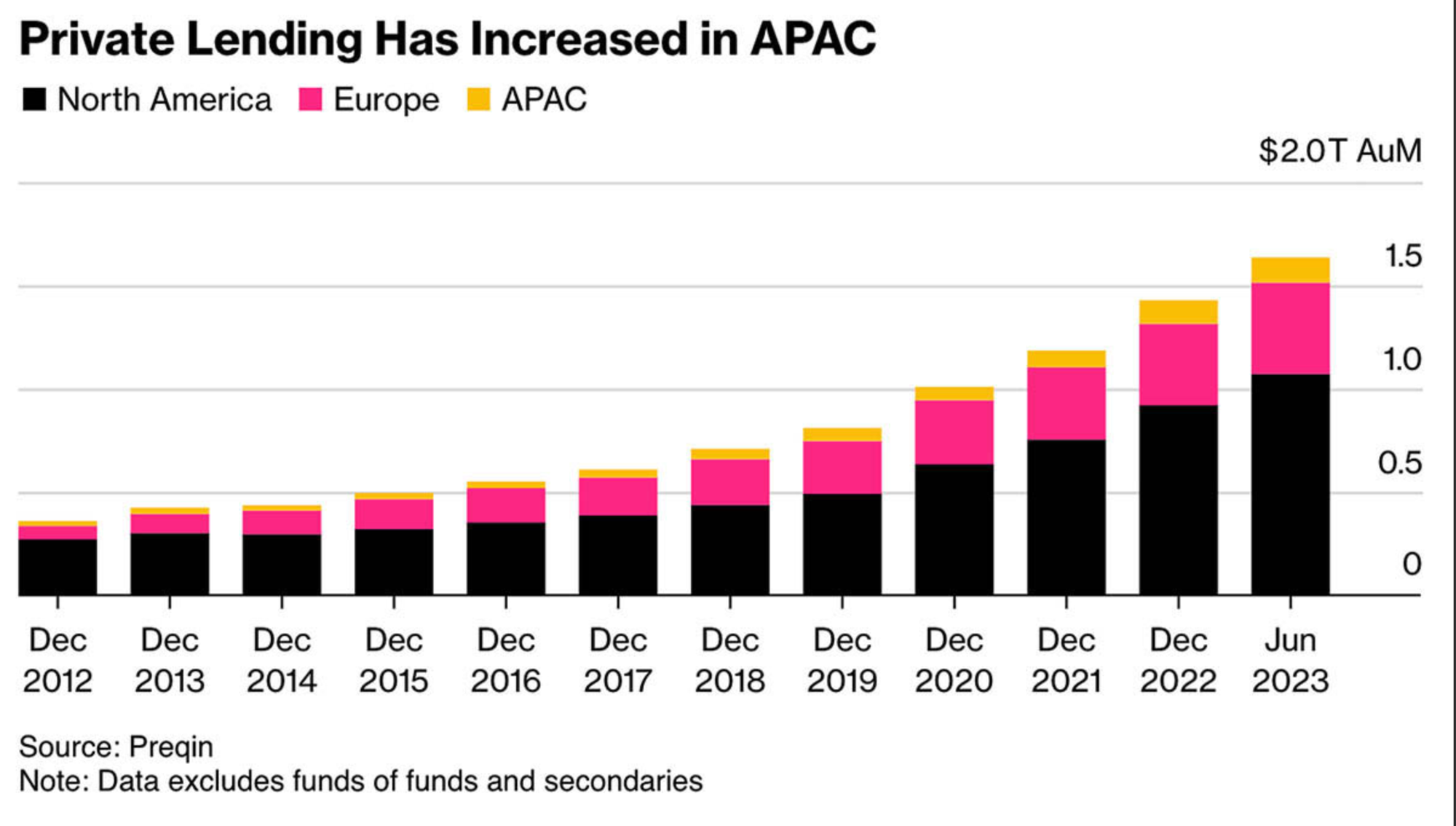
For decades, middle-market corporate borrowers and real estate developers across Asia-Pacific relied almost exclusively on commercial banks for growth debt and refinancing. However, as international regulatory frameworks like Basel IV take full effect and traditional regional banks pull back to de-risk balance sheets, a massive funding gap has opened up across the region.
Stepping into this void are institutional funds and single- and multi-family offices across Singapore, Hong Kong, and Sydney. Private credit in APAC has rapidly shifted from a niche, opportunistic allocation into a core fixed-income replacement—delivering attractive risk-adjusted yields and structural downside protection in an uncertain macroeconomic environment.
1. The Bank Disintermediation Wave
Traditional commercial lenders across North and Southeast Asia face tightening regulatory capital requirements, forcing them to restrict loan-to-value (LTV) ratios and scale back middle-market corporate originations.
While bank retrenchment creates operational friction for growing enterprises, it offers non-bank capital providers an unprecedented origination pipeline.
- Speed and Flexibility: Private credit managers can structure custom, flexible financing solutions—such as unitranche facilities and growth capital debt—in weeks, compared to multi-month underwriting timelines at regional banks.
- Equity-Like Returns with Debt Security: Direct lending in APAC currently generates net yields of 9% to 14%, offering a 200 to 400 bps premium over comparable public fixed-income instruments.
- Low Correlation and Mark-to-Market Stability: Unlike public corporate bonds, private loans are held at amortized cost or periodic valuation, insulating portfolios from daily public market volatility.
2. Senior Secured vs. Mezzanine Allocation Tranches
Asian family offices entering private credit are deploying capital primarily across two distinct risk-reward profiles:
+-----------------------------------------------------------------------+
|                    APAC PRIVATE CREDIT STRUCTURES                     |
+-------------------+--------------------+------------------------------+
| Tranche           | Target Net Yield   | Downside Safeguards          |
+-------------------+--------------------+------------------------------+
| Senior Secured    | 8% – 11%           | First-lien mortgages, asset  |
| Direct Lending    |                    | pledges, conservative LTVs   |
|                   |                    | (50%–60%).                   |
+-------------------+--------------------+------------------------------+
| Structured /      | 12% – 16%          | Second-lien security, strict |
| Mezzanine Debt    |                    | cash-flow covenants, equity  |
|                   |                    | kickers/warrants.            |
+-------------------+--------------------+------------------------------+
Family office principals are increasingly demanding first-lien asset coverage and stringent financial covenants—such as minimum debt service coverage ratios (DSCR) and personal/parental guarantees—to cushion against regional default risks.
3. High-Growth Regional Corridors & Sector Focus
Capital deployment across APAC private credit is far from uniform. Managers are targeting specific geographic corridors and resilient sectors:
- Southeast Asia (Singapore, Thailand, Vietnam): Focus on supply-chain logistics infrastructure, cross-border trade finance, and technology platforms seeking non-dilutive capital.
- Australia & New Zealand: Real estate construction debt and mid-market corporate buyouts where bank lending retrenchment has been most pronounced.
- India & Developed North Asia: Performing credit facilities and special-situations financing tied to high-margin manufacturing and digital infrastructure.
Key Takeaway for Asian Allocators
Private credit in Asia-Pacific has reached an inflection point. As traditional bank lending remains constrained, non-bank capital providers who command local deal sourcing and disciplined underwriting capabilities are uniquely positioned to capture equity-like returns with senior secured protection.
Why Asia's Family Offices Are Moving Into Private Credit
This video provides an overview of how Asian family offices are substituting traditional fixed income with private credit to capture higher yields and mitigate market volatility.